
JDA References
Sorted by Implementation Date

Kuwait – Saudi Arabia
JDA2#KWSA
Asia
Summary:
Unique Joint Development Agreement covering onshore and offshore overlapping claims. The 1965 Agreement between the parties divided the onshore Neutral Zone and created an offshore Joint Development Zone. The subsequent agreement in 2000 further defined the offshore zone to be developed through joint operations and joint investment.
Implementation Date: 7 July 1965 (for Agreement A) and
July 2000 (for Agreements B and C)

Argentina - UK (South Atlantic)
JDA20@ARUK
Americas
Summary:
Argentina and the United Kingdom both claim sovereignty over the Falkland (Malvinas)
Islands in the South Atlantic. After the war in 1982, in October 1989, the two States issued a Joint Statement concerning the sovereignty dispute. The Joint Statement made it clear that the document did not represent any sovereignty claim over the Falkland or South Georgia Islands.
After a number of further statements and diplomatic setbacks, a Joint Declaration was issued in 1995 concerning the management of both States’ overlapping continental shelf claims.
The 1995 Joint Declaration established a programme of coordinated activities and provided for the creation of six special cooperation areas. Apart from the limited exploration activities, the declaration was not fully implemented.
The JDA agreement was cancelled by Argentina in 2007 after the election of a hard-line government in Argentina.
Implementation Date: Both Agreements signed on 30 January 1974 and registered 20 May 1981 (in Japan)

Equatorial Guinea - Nigeria Copy
JDA21@EGNI
Africa
Summary:
In September 2000, Equatorial Guinea and Nigeria signed a treaty in view of a partial
delimitation of their maritime boundary after exploration resulted in discoveries in an area of their offshore overlapping claims. At the time, Cameroon contested the treaty.
Article 2 of September 2000 excluded the Ekanga “cut- out” area in the Nigerian side of the boundary line which remained under Nigerian jurisdiction. The subsequent 2003 Protocol was a unitization agreement which granted Equatorial Guinea jurisdiction on the Unit Area created over Ekanga area.
Though the operations are in Nigerian waters, Equatorial Guinea law applies to
the activities of the oil company acting as operator in the Unit Area, including employment, customs, tax, environment and other laws. This arrangement permitted the unit operator, the concession holder on the Equatorial Guinea side and the unit operator on the Nigerian side, to work under a single legal regime and to avoid the difficulties and potential contradictions of having two sets of laws apply to a single operation.
A. Implementation Date: 23 September 2000.
B. Signature on 2 April 2002, entry in force: 29 June 2002

Nigeria – Sao Tome & Principe
JDA22@NISP
Africa
Summary:
The maritime boundary between the states remained unconfirmed after Nigeria rejected Sao Tomé & Principe’s equidistance boundary claim on the basis that Nigeria’s longer coastline warranted an adjustment in its favor. Nigeria also did not accepted Sao Tome’ archipelagic baseline drawn between the islands of Sao Tome and Principe.
In 2000, the two States agreed to a JDA arrangement in the area of overlapping claims. The northern portion of the JDA was defined by EEZ outer limit claimed by Sao Tome and Principe, in the case Principe island were to be given full effect, and the southern line represented the limit of the Nigerian maximalist claim giving no weight to Principe island in delimitating its EEZ. The revenue split is unusual: Nigeria 60 per cent, São Tome and Principe 40 per cent.
In 2001, a Joint Ministerial/ Technical Committee created the Joint Development Authority to conduct the management of the JDA aimed at achieving optimum commercial utilization.
Agreement Date: 21 February 2001
Cambodia - Thailand
JDA23@CATH
Asia
Summary:
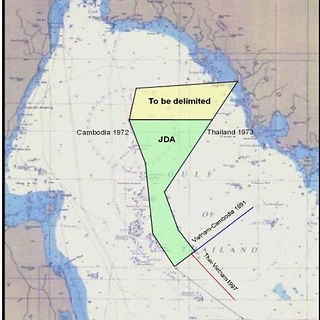
The Memorandum of Understanding (MOU) between Thailand and Cambodia for the area of overlapping continental shelf claims in the Gulf of Thailand was signed in 2001. The area covered by the MoU coincides with the overlapping claims area and is an area believed to be highly prospective for hydrocarbon resources.
The MOU contained general commitments to establishment cooperative management of the relevant overlapping claims area and called for the establishment of a ‘Joint Technical Committee’ that is responsible for drafting the terms of the contemplated joint development and delimitation agreement.
In late 2009 the Thai Government announced its revocation of the agreement after Cambodia’s appointment of a former Thai Prime Minister as an economic adviser to the Cambodian Government. It is not clear if this has formally been done. The MOU is, nonetheless, seen as a positive step forward towards resolution of this longstanding maritime dispute.
Implementation Signed 18 June 2001 (Revoked by Thailand in 2009)

Abu Dhabi - Qatar
JDA3#ADQT
Asia
Summary:
The 1969 maritime delimitation agreement between Qatar and Abu Dhabi (prior to creation of the UAE) called for the development of the cross-border al-Bunduq field to be developed by Abu Dhabi. The ownership and revenues would be divided equally, subject to terms of the
respective concession agreement.
Implementation Date: March 1969

Iran - Sharjah (UAE)
JDA4#IRSH
Asia
Summary:
The 1971 Memorandum of Understanding signed by Iran and Sharjah regarding the status of disputed islands included conditions for the joint occupation of the island of Abu Musa and the delimitation of a 12 nm territorial sea, and also recognized the rights granted by Sharjah to a private company for the exploration of the oil resources of the seabed. Revenues from the field exploitation were to be shared between Iran and Sharjah, now part of the UAE. Ongoing tension continue and the MOU is considered expired.
Implementation Date:29 November 1971 (Currently Inactive)

Japan - Korea
JDA5#JPKO
Asia
Summary:
In 1974, the first JDA agreement outside the Persian Gulf was executed between Japan and South Korea for an area in the East China Sea. The 80,000 km2 joint development zone, still nominally active today, covers their overlapping maritime claims in the East China Sea. China protested its formation, which delayed Japanese ratification of the JDA agreement until 1977. Seven non-commercial exploration dry wells have been drilled in the JDA with no hydrocarbon resources identified.
Implementation Date: Both Agreements signed on 30 January 1974 and registered 20 May 1981 (in Japan)

France - Spain
JDA6#FRSP
Europe
Summary:
The 1974 Convention between France and Spain delimitated their continental shelf boundary and established a complementary joint development scheme. Both governments retain sovereignty and jurisdiction over the 'zone speciale' joint zone, providing for joint ventures between the companies operating in each sector and the export of the resources recovered from the sector of one State to the other State.
Implementation Date: 29 January 1974

Saudi Arabia - Sudan
JDA7@SASU
Asia
Summary:
The 1974 Agreement was the first JDA agreement involving an African state. The Agreement delimited sea-bed boundaries and created a ‘Common Zone’ joint development zone to be run by a Joint Commission. Unusually, the Common Zone is defined as the area in the middle of the Red Sea after each country’s exclusive sovereign rights up to a line where the depth of the super-adjacent waters is under 1,000 meters. The Joint Commission has the sole decision on exploitation of any deposit within the zone, and provides for an equitable share of the proceeds being guaranteed for each government.
Implementation Date: 16 May 1974

Norway – UK (Frigg Field)
JDA8@NOUKF
Europe
Summary:
The first UK – Norway field development agreement signed after the 1965 UK – Norway Delimitation Agreement was for the development of the Frigg field in 1976. Frigg is a field in the central part of the North Sea, straddling the border between the UK and Norwegian sectors.
At the time of discovery in 1971, the Frigg field was the world’s largest offshore gas field. Signed on May 10, 1976 and entering into force on July 22, 1977, the Frigg Agreement became Norway’s first unitization agreement. Since then, the Agreement has been a precedence for many global unitization agreements.
The agreement called for each company in the cross-border group development group to have a share in the license and invest in development proportionately. Together the companies form a license or management Committee which approves, and controls work plans, appointing one company as the operator who carries out the work. The Frigg field was shut down in 2004.
Implementation Date: Signed on 10 May 1976, (entered into force 22 July 1977)
Norway – UK (Stratford Field)
JDA9@NOUKS
Europe
Summary:
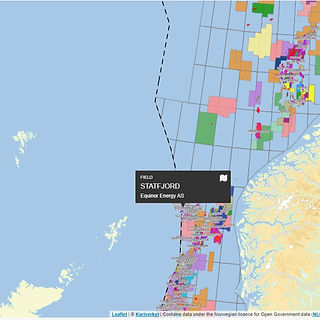
Statfjord was the second transborder field to be developed as a single unit in the North Sea.
Statfjord is a field in the northern part of the North Sea, on the border between the Norwegian and UK sectors.The Norwegian share of the field was determined to be 85.47 per cent. The Statfjord was discovered in 1974, and is still producing.